
Learning Lounges
In our recurring online seminar format, we present exciting and current bioeconomy topics and discuss them together. Four times a year, the one-hour Learning Lounges offer space for practical knowledge exchange - between regional players and at national level. Join us and contribute your perspective to the dialogue!
Missed Learning Lounges?
No problem - you can view all past sessions here on the site at any time!
Help shape the TransBIB Learning Lounges!
Your feedback is important to us: please take a few minutes to complete our short questionnaire.
Your feedback will help us to further develop the TransBIB Learning Lounges in a targeted manner and tailor them even better to your needs.
Thank you very much for your support!
Learning Lounge: Out of the LabScaling infrastructure for the industrial bioeconomy in Germany
In order to bring new bioeconomy processes to market more quickly, we need facilities where processes can be scaled up and optimised. In this Learning Lounge, we present existing and planned facilities for scaling up. We will explain how these facilities can be utilised to develop processes that have been tested in the laboratory to a scale relevant to production, thereby better demonstrating their economic viability.
When the video is played, external content from YouTube is loaded.
In the process, information about the user is collected by the respective provider. It cannot be ruled out that the data collected in this way will be processed in the USA. For more information, please refer to our privacy policy.
Learning Lounge: Best Practices in the Industrial Bioeconomy
The bioeconomy – which refers to a modern and sustainable form of economic activity based on the efficient use of biological resources such as plants, animals and microorganisms – offers many long-term benefits. However, in order for new processes to become competitive, a number of hurdles must be overcome – ranging from ensuring the reliable availability of biological resources to securing sufficient funding. In this Learning Lounge, two companies that have overcome these hurdles will be presenting their work. Look forward to fascinating insights and an open discussion with these companies.
When the video is played, external content from YouTube is loaded.
In the process, information about the user is collected by the respective provider. It cannot be ruled out that the data collected in this way will be processed in the USA. For more information, please refer to our privacy policy.
Learning Lounge: Novel Foods A passing fad or the food of the future?
The world of nutrition is constantly changing. Novel foods currently play a significant role. Their diversity and innovative potential are impressive: from plants with previously unknown nutrient contents, through precision fermentation, to cellular agriculture, they offer a wide range of possibilities for the future of nutrition. Whilst some see them as a solution to the growing challenges in food production and supply, there are also concerns regarding acceptance and hurdles to scaling up. The Learning Lounge will provide an update on the current state of play in the field of novel foods – from regulatory frameworks to the latest developments in research and industry. In addition, two companies will offer us fascinating insights into their success stories and the milestones they have achieved on the path to industrial-scale production.
When the video is played, external content from YouTube is loaded.
In the process, information about the user is collected by the respective provider. It cannot be ruled out that the data collected in this way will be processed in the USA. For more information, please refer to our privacy policy.
Learning Lounge: Life Cycle Assessment (LCA)Understanding, Applying and Interpreting
This Learning Lounge will focus on life cycle assessment (LCA). LCA is a key tool for evaluating the environmental impacts of products and processes throughout their entire life cycle. As well as covering the fundamental principles of LCA, the session will also include a practical element: you will have the opportunity to ask questions about the assessment process using a case study. The Learning Lounge will cover the process from data collection, through the various standards – such as ISO 14040 – right through to the communication of results.
When the video is played, external content from YouTube is loaded.
In the process, information about the user is collected by the respective provider. It cannot be ruled out that the data collected in this way will be processed in the USA. For more information, please refer to our privacy policy.
Learning Lounge:
The ‘Industrial Bioeconomy’ funding scheme
Are you looking to scale up a new bio-based product or process? Do you want to use – or even build – a pilot plant? Do you want to establish an innovation cluster in your region? Then the new version of the ‘Funding Guidelines for the Establishment of an Industrial Bioeconomy through the Further Development and Scaling-up of Bio-based Processes and the Establishment of Regional Innovation Clusters’ (Industrial Bioeconomy Funding Programme) from the Federal Ministry for Economic Affairs and Climate Action is just what you need.
When the video is played, external content from YouTube is loaded.
In the process, information about the user is collected by the respective provider. It cannot be ruled out that the data collected in this way will be processed in the USA. For more information, please refer to our privacy policy.
Learning Lounge:
Wastewater with added value – Strategies for the smart use of process water
Water is an indispensable raw material in the bioeconomy – from agriculture through food processing to the chemical industry. The efficient use of process water offers great potential: valuable materials can be recovered, energy can be extracted from wastewater, and water flows can be managed more sustainably. At the same time, however, the demands on water treatment, compliance with legal requirements and the management of conflicts over water use are increasing.
When the video is played, external content from YouTube is loaded.
In the process, information about the user is collected by the respective provider. It cannot be ruled out that the data collected in this way will be processed in the USA. For more information, please refer to our privacy policy.
Learning Lounge:
The biomass dilemma: Are there ways out of the ‘chicken-and-egg problem’?
Agriculture plays a key role in the transition towards a sustainable industrial bioeconomy. Scaling-up projects can only be successfully implemented if biomass is supplied in sufficient quantities and of sufficient quality. However, implementation presents challenges: Farmers are often reluctant to switch their production until there are long-term guarantees of off-take – and, conversely, buyers can only access sufficient quantities once farms have made the switch. How can supply and demand be structured in such a way that change can also take place on a larger scale?
When the video is played, external content from YouTube is loaded.
In the process, information about the user is collected by the respective provider. It cannot be ruled out that the data collected in this way will be processed in the USA. For more information, please refer to our privacy policy.
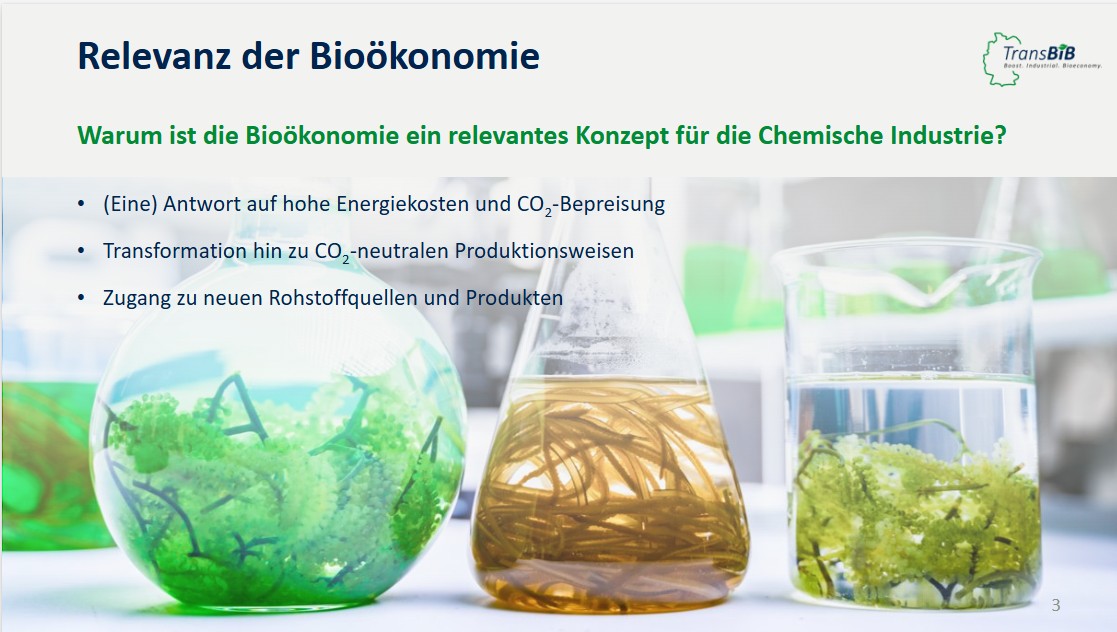
The relevance of the bioeconomy
Why is the bioeconomy a relevant concept for the chemical industry?
This webinar highlights the need for a shift towards the use of residual materials, the challenges associated with biomass utilisation, and the limitations of recycling.
When the video is played, external content from YouTube is loaded.
In the process, information about the user is collected by the respective provider. It cannot be ruled out that the data collected in this way will be processed in the USA. For more information, please refer to our privacy policy.
Learning Lounge on the TransBIB One-Stop Shop: TransBIB in practice - How to find knowledge, tools & partnerships
In this Learning Lounge, you will learn how the TransBIB one-stop shop supports research, industry and practice in implementing bioeconomic projects more quickly and in a more networked way.
Discover the full range of services: from the AI-powered TransBIB Bot, through databases and digital tools, to the expertise pool, matching platform and certification overviews.
When the video is played, external content from YouTube is loaded.
In the process, information about the user is collected by the respective provider. It cannot be ruled out that the data collected in this way will be processed in the USA. For more information, please refer to our privacy policy.
Learning Lounge:
Scaling up bioprocesses
From a shake flask to a production plant: scaling up biotechnological processes to an industrial scale is the key to establishing and accelerating industrial biotechnology. In this Learning Lounge, we show why scale-up is far more than simply making reactors bigger.
When the video is played, external content from YouTube is loaded.
In the process, information about the user is collected by the respective provider. It cannot be ruled out that the data collected in this way will be processed in the USA. For more information, please refer to our privacy policy.
Learning Lounge:
Automated, digital, future-proof: practical ideas for the bioeconomy
Digital technologies are currently transforming the entire value chain in the bioeconomy. Data-driven decision-making, automated processes and machine learning systems are opening up new opportunities to use resources more efficiently, shorten development cycles and make work processes safer. The Learning Lounge provides a clear overview of what is already feasible today and the specific opportunities this presents for different organisations.
When the video is played, external content from YouTube is loaded.
In the process, information about the user is collected by the respective provider. It cannot be ruled out that the data collected in this way will be processed in the USA. For more information, please refer to our privacy policy.
Learning Lounge:
Developing competence hubs for the industrial bioeconomy
Practice, comparison and lessons learnt
Germany as an industrial hub is facing far-reaching changes: climate policy targets, global competitive pressure and structural change in traditional sectors call for new economic approaches and profiles. The industrial bioeconomy offers new prospects in this regard for rural, urban and industrial areas alike, enabling regions to pool their technical and economic potential in order to retain value creation locally, shape transformation processes and tap into new areas of growth.
When the video is played, external content from YouTube is loaded.
In the process, information about the user is collected by the respective provider. It cannot be ruled out that the data collected in this way will be processed in the USA. For more information, please refer to our privacy policy.
Learning Lounge:
Innovation meets funding
EU funding opportunities for bio-based technologies
The European research programme Horizon Europe offers numerous funding streams to strengthen the bioeconomy. However, the variety of calls for proposals, requirements and funding mechanisms can be challenging. Which programmes are suitable for your research topic? Which areas of technology are currently being funded? What opportunities are available for researchers from companies, universities and non-profit organisations?
When the video is played, external content from YouTube is loaded.
In the process, information about the user is collected by the respective provider. It cannot be ruled out that the data collected in this way will be processed in the USA. For more information, please refer to our privacy policy.

Your direct contact
Dr Lucas Baumgart
Establishing a pool of expertise and tools for knowledge sharing
Provadis University of Applied Sciences
transbib@provadis-hochschule.de