
A successful start for the TransBIB Competence Pool’s LinkedIn group: an online fireside chat on the role of consultancy in the bioeconomy
How do companies find the right consultancy? How important are specialist knowledge, scientific analysis and practical experience? And what contribution can consultancy make to innovation and the development of new business models? These were the questions addressed during the online fireside chat ‘What makes for successful consultancy?’, which served as the launch event for the TransBIB Competence Pool’s new LinkedIn group. The event also provided an opportunity to begin a dialogue with participants at an early stage about the future shape of the community.
Der TransBIB Kompetenzpool
The TransBIB Competence Pool brings together the expertise of over 100 specialists from academia, industry and knowledge transfer organisations within the industrial bioeconomy. The members represent a wide variety of subject areas, sectors and technologies and are available for discussion, advice and collaboration. Through its nationwide network, the Competence Pool helps to identify suitable contacts for specific enquiries, make knowledge accessible and bring innovations into practical application more quickly.
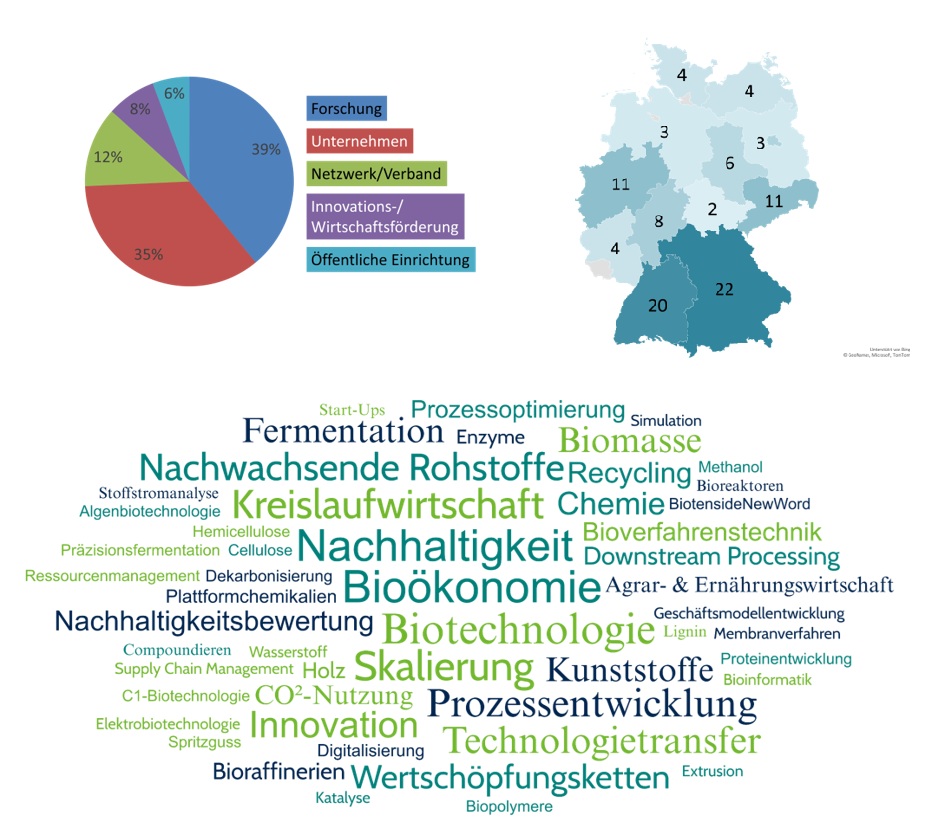
The figure shows the geographic distribution of knowledge experts, the types of organizations they represent, and the topics, industries, and areas of expertise they bring to the table.
A key outcome of the discussion was that successful consultancy goes far beyond the mere imparting of specialist knowledge. In particular, consultancy helps to structure complex issues, analyse challenges systematically and develop viable solutions. It was emphasised on several occasions that companies must first identify their actual consultancy needs: Where does the company stand today? Where does it want to go? And what obstacles stand in the way of this goal? Only on this basis can the appropriate support be found.
When looking for suitable consultants, personal recommendations and references continue to play a crucial role. At the same time, it was pointed out that the range of consultancy services on offer is often difficult to navigate. In addition to professional expertise and industry knowledge, shared values, trust and transparency are therefore also important criteria for a successful collaboration.
As the discussion progressed, the participants focused on the interplay between specialist knowledge, scientific analysis and experiential knowledge. There was agreement that successful consultancy is based on all three pillars. Whilst specialist knowledge forms the foundation and scientific methods provide a robust basis for decision-making, valuable experiential knowledge arises primarily through practical application and ‘learning by doing’. In particular, the ability to correctly interpret data and facts and to derive recommendations for action from them was highlighted as a key added value of consultancy.
The importance of consultancy for innovation and business development was also discussed at length. Start-ups and small and medium-sized enterprises, in particular, often lack the full range of expertise required to bring new products or technologies to market. Consultancy can provide guidance here by creating clarity regarding customer needs, competitive environments, pricing structures, regulatory requirements and technological alternatives. In doing so, it makes an important contribution to accelerating innovation processes and reducing risks.
Another key focus of the informal discussion was the expectations for the future LinkedIn group of the TransBIB Competence Pool. The participants discussed challenges relating to knowledge and technology transfer within the bioeconomy. In particular, it became clear that agricultural businesses often have only limited information about the industry’s future raw material requirements. Conversely, companies often lack an overview of available resources and potential suppliers. In this regard, the wish was expressed to establish TransBIB even more firmly in future as a platform for networking, matching and the exchange of market requirements.
The discussion made it clear that there is a great need for transparency, networking and the practical exchange of knowledge within the bioeconomy. This is precisely where the TransBIB Competence Pool’s new LinkedIn group aims to make a difference: as an open forum for expert dialogue, the exchange of experiences and new collaborations between academia, industry and professional practice.
With a wealth of inspiration, practical ideas and active participation from those present, the fireside chat provided a successful start for the new community and highlighted the central role of consultancy as a bridge between knowledge, innovation and successful implementation.